
Sunday 12th April
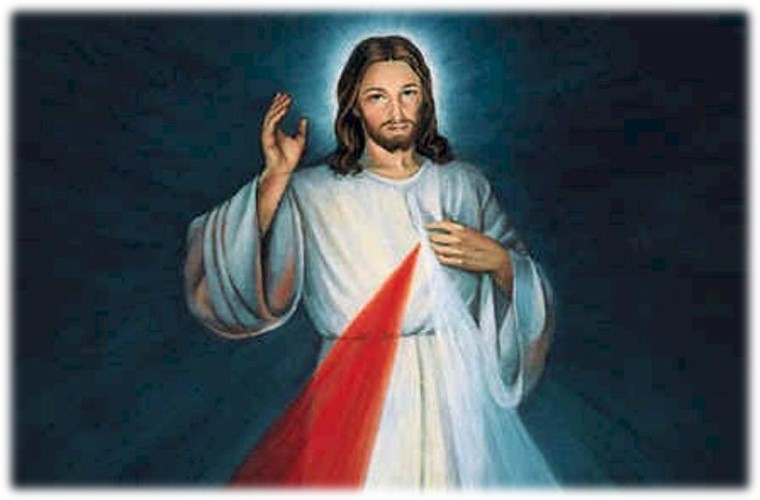
The message of the Divine Mercy is a reminder of what the Church has always taught: that God is merciful and forgiving and that we too must show mercy and forgiveness.
Mercy never allows us to feel satisfied. It is the love of Christ that makes us restless until we reach the goal; it impels us to embrace, welcome and include those who need mercy.
Pope Francis
We shall be celebrating the Feast of Divine Mercy at St Joseph’s on Sunday 12 April with Adoration of the Blessed Sacrament from 2:30pm to 3:30pm, during which we shall pray the Divine Mercy Chaplet.
In preparation for the Feast, you are invited to pray the Divine Mercy Novena which runs from Good Friday 3 April to Saturday 11 April, the day before the Feast. Click here to read/download the Novena.
Jesus chose Sr Faustina (1905-1938) a humble Polish nun, as the Apostle and “Secretary” of His Mercy, so that she could tell the world about His great message, which she recorded in her Diary entitled “Divine Mercy in My Soul”.
Jesus said to her: In the Old Covenant I sent prophets wielding thunderbolts to My people. Today I am sending you with My mercy to the people of the whole world. I do not want to punish aching mankind, but I desire to heal it, pressing it to My Merciful Hearts. (Diary – 1588)
The ABCs of Mercy
The message of mercy is that God loves us - all of us, no matter how great our sins. He wants us to recognise that His mercy is greater than our sins, so that we will call upon Him with trust, receive His mercy, and let it flow through us to others. Thus, all will come to share His joy. It is a message we can call to mind simply by remembering ABC.
- Ask for His Mercy. God wants us to approach Him in prayer constantly, repenting of our sins and asking Him to pour His mercy out upon us and upon the whole world.
- Be Merciful to Others. God wants us to receive His mercy and let it flow through us to others. He wants us to extend love and forgiveness to others just as He does to us.
- Completely Trust in Jesus. God wants us to know that the graces of His mercy are dependent upon our trust. The more we trust in Jesus, the more we will receive.
Pope John Paul II wrote with a new urgency for our own times:
"At no time ... especially at a moment as critical as our own - can the Church forget the prayer that is a cry for the mercy of God. ... The Church has the right and the duty to appeal to the God of mercy 'with loud cries'" (Rich in Mercy, 15).
On 30 April 2000, Pope John Paul II canonized Saint Faustina Kowalska before some 250,000 pilgrims. He also approved the Divine Mercy message and devotion by declaring the Second Sunday of Easter as “Divine Mercy Sunday” for the universal Church.
He said, “By this act of canonization of Saint Faustina I intend today to pass this message on to the third millennium. I pass it on to all people, so that they will learn to know ever better the true face of God and the true face of their neighbour. In fact, love of God and love of one's neighbour are inseparable.”
Pope John Paul II died on the vigil of Divine Mercy Sunday in April 2005, and was canonized by Pope Francis on Divine Mercy Sunday, 27 April 2014. Pope Francis then carried on the Divine Mercy message by instituting the Jubilee Year of Mercy, which was especially devoted to the spiritual and corporal works of mercy, in 2016.
To St Faustina, Jesus revealed this same message once again. He gave her three new ways to ask for mercy on the strength of His passion: the Chaplet, the Novena, and prayer at three o'clock; and He taught her to transform her daily life into a continuous prayer for mercy. Through her, He calls us all to ask for His mercy:
“Souls that make an appeal to My mercy delight Me. To such souls I grant even more graces than they ask. I cannot punish even the greatest sinner if he makes an appeal to My compassion” (Diary – 1146).
“Beg for mercy for the whole world” (Diary – 570).
“No soul that has called upon My mercy has ever been disappointed” (Diary – 1541).
For the prayers go to www.divinemercyapostolate.co.uk.
The Divine Mercy is shown above all in God's closeness to those who suffer. On the cross Jesus united himself to all the pain and desolation of the human condition. Whenever any person suffers, God also suffers.
Pope Francis